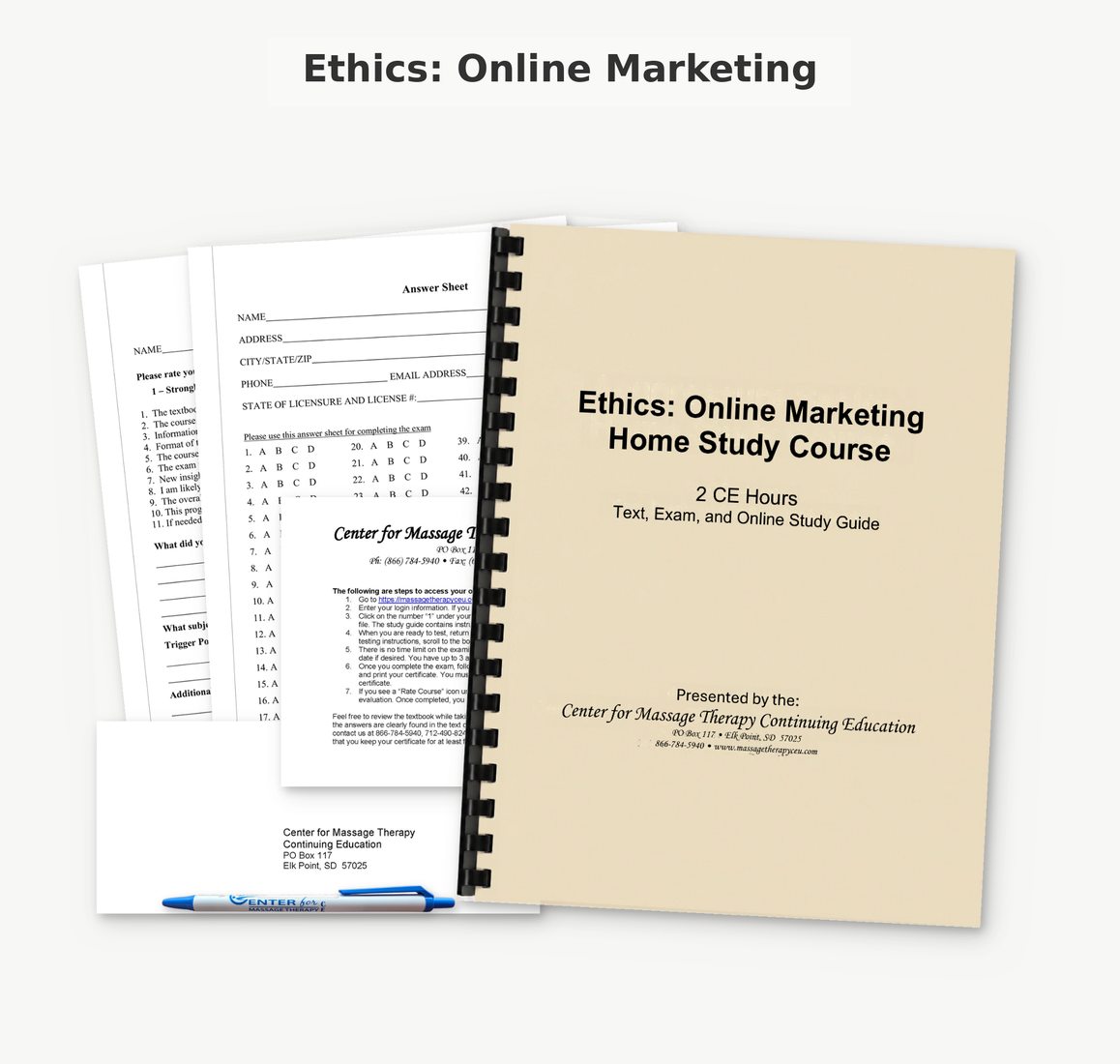
Cost includes all materials. Shipping, if applicable, is a flat rate.
Online marketing is an important part of how massage therapists communicate with potential and current clients. Websites, social media, email, online reviews, testimonials, educational content, and other digital communications can influence how a therapist and practice are perceived. Because these communications represent the therapist professionally, they should be accurate, honest, appropriate, and respectful of client privacy and professional boundaries.
This 2 CE hour course examines ethical considerations involved in online marketing for massage therapists. Topics include understanding your target audience, building a professional online presence, selecting appropriate marketing strategies, evaluating marketing results, managing reviews and testimonials, creating educational content, protecting privacy, maintaining professional boundaries in online communication, and developing an ethical online marketing plan.
In This Course, You Will Learn:
How to understand your target audience and use market information to guide marketing decisions.
How to build and maintain an accurate, professional online presence.
How to select online marketing methods that fit your practice, audience, resources, and goals.
How to evaluate marketing results using meaningful measures rather than relying only on followers, views, or website traffic.
The difference between online reviews and testimonials and how to manage each appropriately.
How to encourage honest client feedback without creating pressure or misleading impressions.
How to protect client privacy when responding to reviews, testimonials, photographs, and other online content.
How to create educational content using reliable sources and avoid unsupported health claims.
How to maintain appropriate professional boundaries when communicating through email, messaging, and social media.
How to create and evaluate a practical ethical online marketing plan.
Why Take This Course?
An online presence can be one of the first ways a potential client encounters a massage therapist. What appears on a website, social media account, review platform, or other digital channel can create expectations about the therapist's qualifications, services, professionalism, and approach to client care. Understanding the ethical responsibilities associated with these communications can help massage therapists present their practices accurately while maintaining appropriate professional standards.
This course provides practical guidance for making ethical decisions about online marketing rather than simply focusing on how to attract more attention. It addresses common situations massage therapists may encounter, including client reviews, testimonials, health-related claims, online messages, educational content, privacy concerns, and the ongoing management of a professional online presence.
Define market analysis and identify ways to use market information to guide ethical marketing decisions.
Describe characteristics of an accurate, professional online presence and identify appropriate marketing methods for a massage therapy practice.
Explain how to evaluate marketing results using meaningful measures, including the difference between revenue and profit.
Distinguish between online reviews and testimonials and identify ethical practices for managing client feedback and testimonials.
Identify reliable sources of information and recognize ethical concerns related to unsupported health claims, personal experience, and online content.
Describe appropriate professional boundaries and privacy practices for email, messaging, social media, photographs, reviews, and other online communication.
Develop an ethical online marketing plan that incorporates professional communication, privacy, appropriate boundaries, meaningful measurement, and ongoing evaluation.
The Center for Massage Therapy Continuing Education, LLC is an Approved Provider through the National Certification Board for Therapeutic Massage and Bodywork (NCBTMB); Approved Provider number 409296-00.
Our massage online continuing education courses are also accepted by the American Massage Therapy Association (AMTA), Associated Bodywork and Massage Professionals (ABMP), and most state boards.
For more information on individual state requirements and approvals, please visit our Approvals page and click on your state.
Learned new things instead of the old school boring ethics CEU's required for relicensure! - Traci Harris
I especially liked how website analytics were discussed. This is something rarely discussed. - Hannah Woltman
I found it to be very interesting and helpful in marketing my practice. As a therapist with 20 years in the industry, it was refreshing to find an ethics course different from all the others I have taken over the course of my career. There was nothing I disliked. - Leslie Kahn
Information was presented in an easily understandable format. - T. Sayers, LMT
The instructions were simple. The content was clear. - L. Valentine, LMT
Relevant, easy to apply information! - Paige Thomas, LMT
Which is identified as a common problem that can reduce the effectiveness of an online marketing presence?
A. Maintaining accurate information about the practice
B. Excessive promotional content
C. Using educational information to reduce uncertainty
D. Providing useful answers to common client questions
Which of the following is identified as a potentially reliable source for factual health or science information?
A. Peer-reviewed research
B. An anonymous social media post
C. An unsourced online advertisement
D. A website selected only because it appears professional
Which of the following is NOT a good question to ask before information is published?
A. Is the information accurate and current?
B. Does the content provide the correct guarantee?
C. Does it protect client privacy?
D. Does it maintain professional boundaries?
Course Author
About the Instructor
Corrine Rubida, BS, LMT
Corrine completed her massage therapy training at Gateway College of Massage Therapy in 1997 and earned a Bachelor of Science degree in Healthcare Administration in 2012. She has been practicing and teaching massage therapy since 1997 and currently holds a massage therapy license in South Dakota. She is also a member of the ABMP. In 2000, Corrine founded the Center for Massage Therapy CE to make professional massage continuing education courses available both online and by mail. Since then, she has developed more than 100 home-study massage continuing education courses and has taught live courses for AMTA and the Gateway College of Massage Therapy.