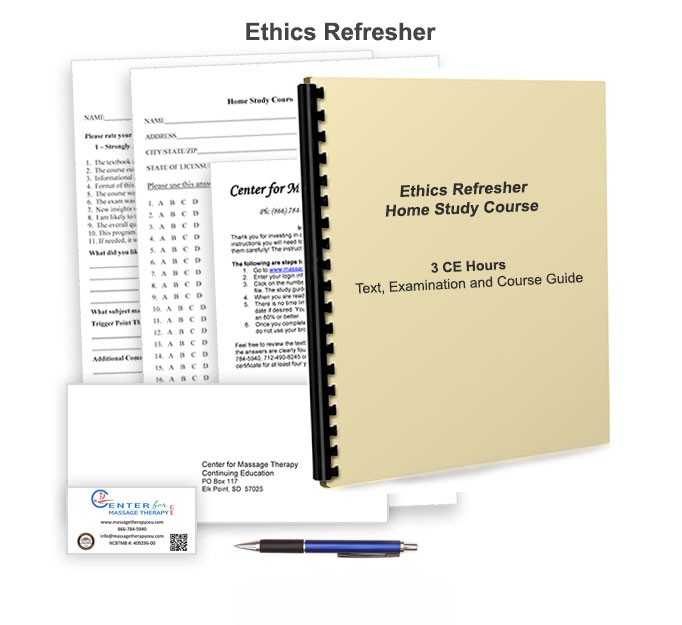
Cost includes all materials. Shipping, if applicable, is a flat rate.
New course September 2026! Effective communication is an essential part of ethical massage therapy practice. This course examines how massage therapists can communicate honestly, respectfully, and professionally with clients, healthcare professionals, coworkers, and the public. Topics include active listening, professional boundaries, communicating credentials and services accurately, written and digital communication, marketing and social media, confidentiality, referrals, and responding appropriately when something goes wrong.
Through practical examples and communication scenarios, the course focuses on applying ethical principles to everyday situations. You will learn how to recognize communication risks, protect client privacy, avoid misrepresenting your qualifications or scope of practice, handle difficult conversations, and seek appropriate guidance when a situation is unclear.
In This Course, You Will Learn:
How ethical communication supports professional massage therapy practice
How to use active listening and client-centered communication
How to establish and maintain appropriate professional boundaries
How to communicate education, credentials, services, and professional limitations accurately
How to maintain professionalism in written, digital, and electronic communication
How to approach marketing, advertising, reviews, and social media ethically
How to communicate appropriately with other healthcare professionals and make referrals
How to respond honestly and professionally when a mistake or communication problem occurs
How confidentiality and privacy apply to professional communication
How to apply ethical communication principles to common workplace and client scenarios
Why Take This Course?
Communication affects nearly every aspect of massage therapy practice. The way a therapist speaks, writes, responds to concerns, describes services, handles disagreements, and shares information can affect professional relationships, client trust, and ethical practice.
This course provides practical guidance for handling real-world communication situations while maintaining professional boundaries, protecting client privacy, communicating within appropriate professional limits, and representing your qualifications and services accurately.
Identify foundational principles of ethical professional communication.
Apply active listening and client-centered communication techniques.
Recognize and maintain appropriate professional boundaries.
Distinguish between education, training, certification, licensure, and experience when communicating professional qualifications.
Identify ethical practices for written, digital, marketing, and social media communication.
Describe appropriate communication with clients and other healthcare professionals.
Apply confidentiality and privacy principles when sharing client information.
Respond appropriately to complaints, disagreements, mistakes, and uncertain communication situations.
Recognize when a situation requires referral, additional information, or professional guidance.
Apply ethical communication principles to practical massage therapy scenarios.
Text: Ethics: Professional Communication by Corrine Mollet Rubida, BS, LMT, 78 pages
Course instruction guide
20-question multiple-choice final exam
Course evaluation
Certificate of Achievement upon completion
Unlimited phone support for course-related questions
The Center for Massage Therapy Continuing Education, LLC is an Approved Provider through the National Certification Board for Therapeutic Massage and Bodywork (NCBTMB); Approved Provider number 409296-00.
Our massage online continuing education courses are also accepted by the American Massage Therapy Association (AMTA), Associated Bodywork and Massage Professionals (ABMP), and most state boards.
For more information on individual state requirements and approvals, please visit our Approvals page and click on your state.
Packed with pertinent information. - A. Lutes, LMT
I liked the information that was provided. It gave me more tools to add to professional communication. - K. Pelanek, LMT
Very helpful with the resume info. - Rachel Carey, LMT
It was a quick read but was good to refresh my resume and interview skills. - Antoinette McKee, LMT
What should a therapist do when ethical practice does not have an obvious answer?
A. Respond immediately to avoid appearing uncertain
B. Make the most reasonable assumption
C. Pause, gather additional information, seek appropriate guidance, or consider several possible responses
D. Allow the client to make the professional decision
Why should written communication be approached with the same attention to professionalism as spoken communication?
A. Written communication is always more formal than spoken communication
B. Written and digital communication still represent the massage therapist professionally
C. Written communication cannot be misunderstood
D. Digital communication eliminates the need for professional judgment
Which of the following is NOT considered communicating relevant information?
A. Communicating to another healthcare professional what the client reported
B. Communicating to another healthcare professional what the therapist observed
C. Communicating to another healthcare professional your opinion of the client
D. Communicating to another healthcare professional the reason for referral
Course Author
About the Instructor
Corrine Rubida, BS, LMT
Corrine completed her massage therapy training at Gateway College of Massage Therapy in 1997 and earned a Bachelor of Science degree in Healthcare Administration in 2012. She has been practicing and teaching massage therapy since 1997 and currently holds a massage therapy license in South Dakota. She is also a member of the ABMP. In 2002, Corrine founded the Center for Massage Therapy CE to make professional massage continuing education courses available both online and by mail. Since then, she has developed more than 100 home-study massage continuing education courses and has taught live courses for AMTA and the Gateway College of Massage Therapy.
.jpg)