Cost includes all materials. Shipping, if applicable, is a flat rate.
Learn the principles and techniques of myofascial release in this 16-hour continuing education course for massage therapists. The course explores the myofascial system, muscular anatomy, myofascial meridian lines, gait analysis, and postural patterns while introducing techniques for performing myofascial release throughout the body.
The course covers how myofascial release is performed, its effects on the body, benefits, indications, and contraindications. More than two hours of online technique demonstrations, including a full-body myofascial release session, provide additional visual instruction.
In this course, you will learn:
The principles and practice of myofascial release
Muscular anatomy and the myofascial meridian system
Anatomy Trains Lines and their relationship to myofascial patterns
Gait analysis and assessment of postural patterns
How myofascial release is performed and its effects on the body
Benefits, indications, and contraindications of myofascial release
Basic techniques for performing a full-body myofascial release session
More than two hours of online myofascial release technique demonstrations
Why take this course?
Myofascial release can be an important addition to a massage therapist's skill set. This 16-hour course combines myofascial anatomy, assessment concepts, and practical technique instruction, with more than two hours of online video demonstrations to help reinforce the techniques presented in the course.
Explain the basic principles and theories associated with myofascial release.
Identify major components of the myofascial system and myofascial meridian lines.
Describe the relationship between muscular anatomy, posture, and myofascial patterns.
Explain basic gait analysis and postural assessment concepts.
Describe how myofascial release techniques are performed.
Identify the benefits, indications, and contraindications associated with myofascial release.
Describe basic techniques used during a full-body myofascial release session.
Apply knowledge of myofascial release principles and techniques to professional massage therapy practice.
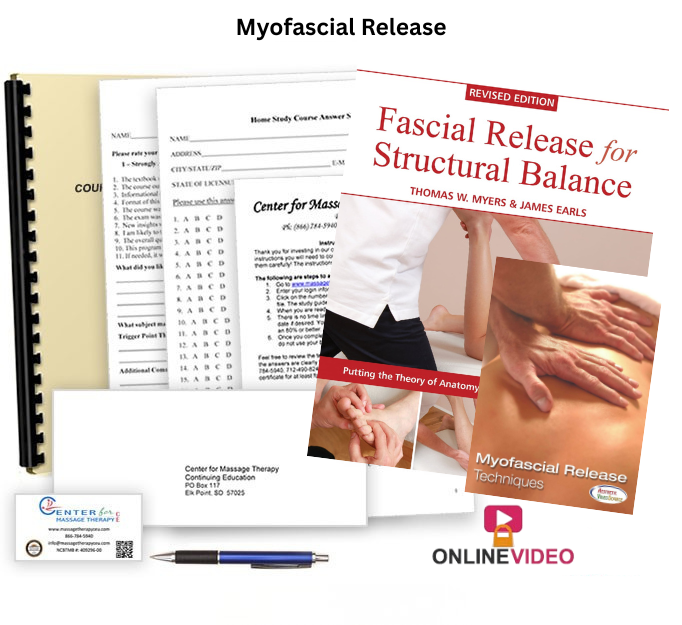
Text: Fascial Release for Structural Balance, Revised Edition, by James Earls and Thomas Myers, 279 pages
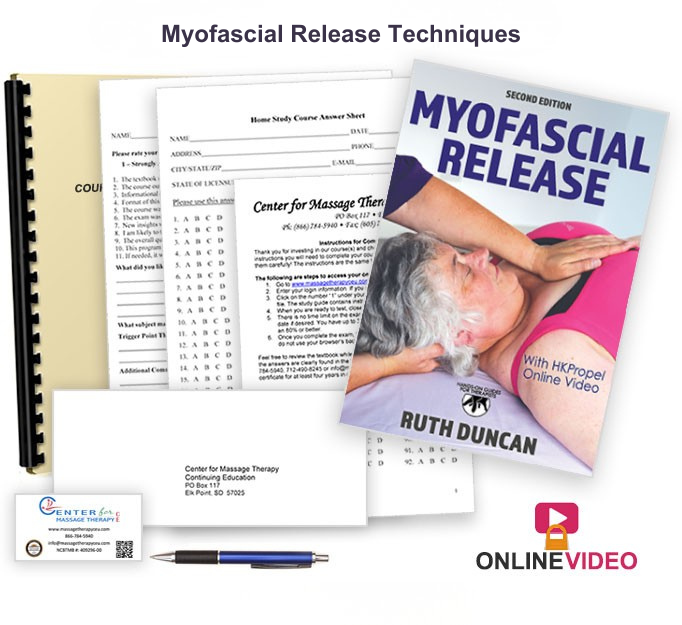
Myofascial Release Techniques online video with John Hoffmann, approx. 3 hours and 30 minutes
Study guide with instructions
81-question online multiple-choice exam
Course evaluation
Certificate of achievement upon completion
Unlimited phone support
The Center for Massage Therapy Continuing Education, LLC is an Approved Provider through the National Certification Board for Therapeutic Massage and Bodywork (NCBTMB); Approved Provider number 409296-00.
Our massage online continuing education courses are also accepted by the American Massage Therapy Association (AMTA), Associated Bodywork and Massage Professionals (ABMP), and most state boards.
For more information on individual state requirements and approvals, please visit our Approvals page and click on your state.
I liked the detail of each individual technique and the in depth language in explanations. - Kimberly Barnes
It was very thorough. I prefer hands on, in person courses, but this suited my needs just fine. - Lydia Tate, LMT
I like that the video demonstrated many myofascial techniques. - Stacey Switzer, LMT
Very interesting modality. Loved all the information presented. - A. Mackey, LMT
I will definately use the information learned in this course in my practice. - Michelle Taylor, LMT
I liked that this course not only enabled me to promote change in my clients, but also gave me clear and precise way to engage the body. - David Mcglohn, LMT
Which of the following is a reason to apply client movement as you work?
A. To more efficiently release each layer of tissue
B. To elicit a pain response from the client
C. To diagnose dysfunction in deeper tissue layers
D. To less efficiently release each layer of tissue
What is the acronym for the five-stage model of the Fascial Release Technique (FRT)?
A. DASIE
B. RICE
C. PUSH
D. MELT
Which of the following structures is the key to many of the dysfunctions that plague the arm and shoulder?
A. The scapula
B. The clavicle
C. The humerus
D. The cervical spine
Course Authors
About the Instructors
Corrine Rubida, BS, LMT
Corrine completed her massage therapy training at Gateway College of Massage Therapy in 1997 and earned a Bachelor of Science degree in Healthcare Administration in 2012. She has been practicing and teaching massage therapy since 1997 and currently holds a massage therapy license in South Dakota. She is also a member of the ABMP. In 2002, Corrine founded the Center for Massage Therapy CE to make professional massage continuing education courses available both online and by mail. Since then, she has developed more than 100 home-study massage continuing education courses and has taught live courses for AMTA and the Gateway College of Massage Therapy.
John Hoffmann, CMT
John Hoffmann is a certified massage therapist, practicing in the Los Angeles area for over 15 years. He completed his massage therapy studies at the Institute of Psycho-Structural Balancing in California. His training is in myofascial release, craniosacral therapy, advanced circulatory techniques, trigger point therapy, foot reflexology, emotional dynamics of the body, acupressure, neuro-muscular re-education, sensory re-patterning, and deep tissue massage. He is the featured expert in the Myofascial Release Techniques and award-winning Craniosacral Therapy Techniques instructional videos. He’s worked in chiropractic offices, as well as massage spas.