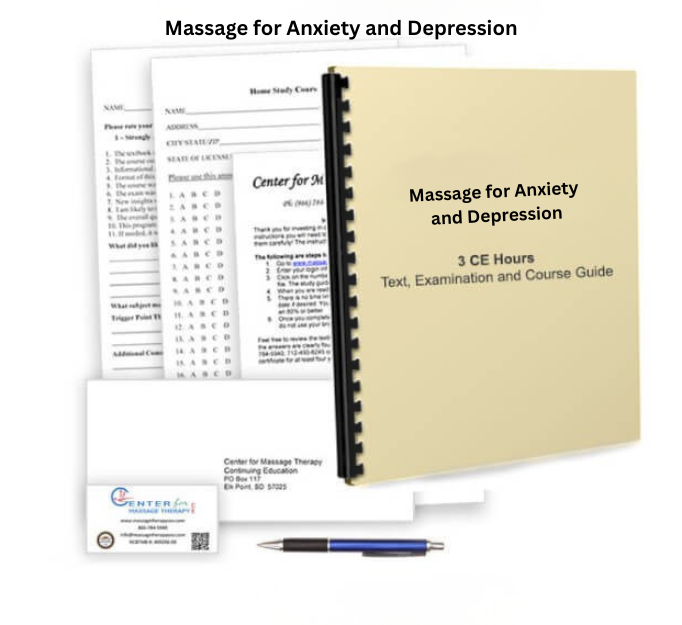
Cost includes all materials. Shipping, if applicable, is a flat rate.
Explore the connection between the mind and body and its relevance to massage therapy in this 15-hour continuing education course. Psychology of the Body examines how psychological and emotional factors may influence the body, client presentation, and the massage therapist-client relationship.
The course explores emotional release, body patterns, therapeutic boundaries, and ways to select massage approaches that are appropriate for individual clients. It also addresses recognizing situations that may require referral to a qualified mental health professional, helping massage therapists maintain appropriate professional boundaries and scope of practice.
In this course, you will learn:
The relationship between psychological and physical aspects of the body
Mind-body connections and their relevance to massage therapy
Emotional release and appropriate professional responses
Common body patterns and their psychological considerations
How to select massage methods appropriate for individual clients
Therapeutic boundaries and ethical behavior
The importance of maintaining a professional therapeutic frame
When referral to a qualified mental health professional may be appropriate
Why take this course?
Massage therapists work with the whole person, and understanding the relationship between emotional and physical experiences can provide valuable context when working with clients. This course helps therapists develop greater awareness of psychological factors that may influence client presentation and the massage therapy relationship.
This 15-hour course is a good choice for massage therapists who want to deepen their understanding of the mind-body connection while strengthening their knowledge of emotional release, professional boundaries, and appropriate referral. It provides information that can support thoughtful, ethical, and client-centered massage therapy practice.
Explain the relationship between psychological and physical aspects of the body.
Describe the concept of mind-body connection and its relevance to massage therapy.
Identify common body patterns and their psychological considerations.
Recognize emotional release and describe appropriate professional responses.
Select massage approaches that are appropriate for individual client needs.
Explain the importance of therapeutic boundaries and ethical behavior.
Recognize situations in which referral to a qualified mental health professional may be appropriate.
Apply mind-body and professional boundary concepts within an appropriate massage therapy scope of practice.
Text: The Psychology of the Body, Enhanced 2nd Edition by Elliot Greene and Barbara Goodrich-Dunn, 304 pages
Course guide with instructions
75-question examination
Course evaluation
Certificate of achievement upon completion
Unlimited phone support
The Center for Massage Therapy Continuing Education, LLC is an Approved Provider through the National Certification Board for Therapeutic Massage and Bodywork (NCBTMB); Approved Provider number 409296-00.
Our massage online continuing education courses are also accepted by the American Massage Therapy Association (AMTA), Associated Bodywork and Massage Professionals (ABMP), and most state boards.
For more information on individual state requirements and approvals, please visit our Approvals page and click on your state.
I enjoyed the expansive knowledge shared in caring for various holding patterns of clients that you may see in your practice and ways better understand what they are presenting and how you can assist them through massage or to refer them to another professional as appropriate. - Cheryl F.
I like the fact that it was very understandable for a massage therapist. - Darlene L.
The subject matter was fascinating and went much more in-depth than I was expecting. The textbook was well laid out and easy to read. - Paige T.
I wish I would have had this book 30 years ago. It is so informative with body structures and how our postures are formed the way they are. I learned a lot about myself in these pages, things that I've been trying to change and understand most of my life. Now, I know how, and I can create a plan. There's a wealth of information here, and I will refer to it often. - Charlsie B.
Loved the text! Will be using as a reference guide. Print was small, though, for me at least. Very comprehensive course. - L. Jensen
This should be a required course. So informative and really helpful. - Jessica E.
What is the term most often used to describe a new model of mind which suggests that we think not just with our brains, but with our bodies?
A. Embodied cognition
B. Represented cognition
C. Symbolized cognition
D. Manipulated cognition
What is an emotional release?
A. An expression of disapproval
B. An extreme stress response to an event or a series of negative events that happened unexpectedly or repeatedly
C. A process of one person accurately reflecting what another person says or feels
D. A process in which previously unexpressed and usually unfelt emotions come to the surface entering awareness and are released through expression
Which of the following is NOT a trait of the collapsed structure?
A. To dissociate thinking from feeling
B. Tendency to be dependent
C. Low aggressiveness
D. Inner feeling of needing to be taken care of and supported
What is the strategy for massage with a client with an achieving rigid structure?
A. Invite disconnected people into their bodies
B. Help the client locate specifically where their pain is
C. Dissolving the system of knots along the posterior half, especially along the back
D. To promote deep relaxation through sustained, still-handed touch
Course Author
About the Instructor
Corrine Rubida, BS, LMT
Corrine completed her massage therapy training at Gateway College of Massage Therapy in 1997 and earned a Bachelor of Science degree in Healthcare Administration in 2012. She has been practicing and teaching massage therapy since 1997 and currently holds a massage therapy license in South Dakota. She is also a member of the ABMP. In 2002, Corrine founded the Center for Massage Therapy CE to make professional massage continuing education courses available both online and by mail. Since then, she has developed more than 100 home-study massage continuing education courses and has taught live courses for AMTA and the Gateway College of Massage Therapy.