
Evidence-Based Massage Therapy: What Does It Mean?
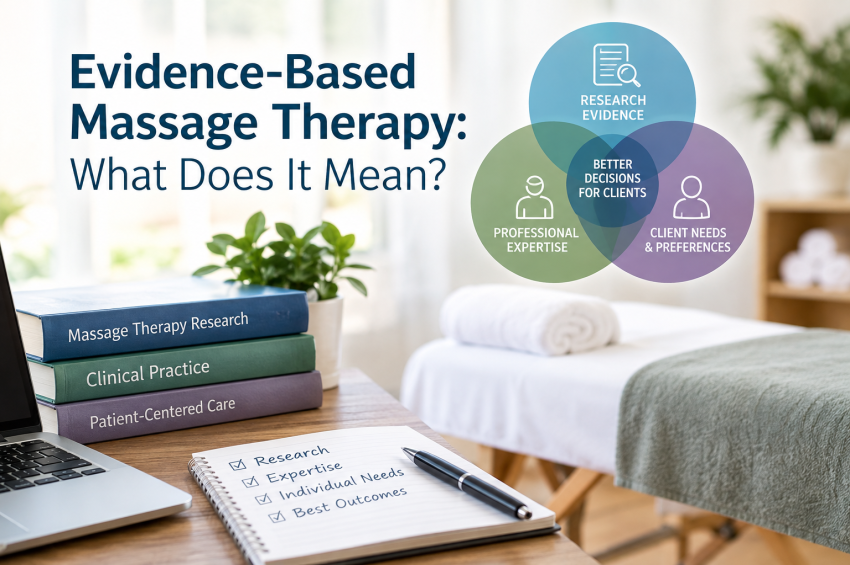
Evidence-Based Massage Therapy: What Does It Mean?
Evidence-based massage therapy means using the best available research evidence, professional expertise, and the individual client's needs, preferences, and circumstances to inform massage therapy decisions. It does not mean that every massage technique must have been proven effective in a clinical trial, nor does it mean that research replaces a massage therapist's professional judgment.
For massage therapists, understanding evidence-based practice can help distinguish research-supported information from traditional explanations, personal observations, marketing claims, and statements that may sound scientific but have limited evidence behind them. It can also help therapists communicate more accurately with clients about what massage may or may not be able to accomplish.
In Simple Terms: What Is Evidence-Based Massage Therapy?
Evidence-based massage therapy is an approach to massage practice that considers what current research tells us, combines that information with professional knowledge and experience, and takes the individual client's needs and preferences into account.
The goal is not to find a single technique that has been "proven" to work for everyone. Instead, evidence-based practice helps massage therapists make informed decisions based on the information available at the time.
This distinction is important because research does not provide a simple yes-or-no answer for every massage technique, condition, or client. Some areas of massage therapy have been studied more extensively than others, and the strength of the evidence can vary considerably.
What Does Evidence-Based Practice Mean for Massage Therapists?
Evidence-based practice involves more than finding a research study that supports a particular technique. A massage therapist practicing in an evidence-informed manner might ask what current research says about a particular issue, how strong that evidence is, whether the research applies to the client, and what limitations the research has.
The therapist also considers the client's goals, preferences, health history, previous experiences, and circumstances. Professional education, training, and clinical experience are also part of the decision-making process.
In other words, evidence can inform a massage therapist's decisions without dictating exactly what every massage session must look like.
The Three Parts of Evidence-Based Practice
Evidence-based practice is commonly described as bringing together three important elements: the best available research evidence, professional expertise, and the individual client's values, preferences, and circumstances.
The Best Available Research Evidence
Research provides information about what researchers have observed when a particular intervention is studied. Massage therapy research can include randomized controlled trials, observational studies, systematic reviews, meta-analyses, and other types of scientific investigation.
Different research designs can answer different questions. A randomized controlled trial, for example, may compare an intervention with a control or comparison condition. A systematic review can examine findings from multiple studies to provide a broader picture of the available evidence.
However, the existence of a published study does not automatically mean that a treatment has been scientifically established. A therapist should consider how the study was designed, how many people participated, what was actually studied, how outcomes were measured, what the comparison group received, and what limitations the researchers identified.
The quality, relevance, and consistency of the evidence matter.
Professional Expertise
Research is only one part of evidence-based practice. Professional expertise is another.
Massage therapists develop knowledge through formal education, supervised training, continuing education, and experience working with clients. That knowledge can help a therapist determine how research findings may or may not apply to a particular person.
Clinical experience, however, is not the same as scientific evidence. A therapist may observe that many clients appear to respond positively to a particular approach. That observation may be useful in clinical decision-making, but it does not establish that the technique will produce the same result in everyone or prove why a particular response occurred.
Professional experience and research evidence can both contribute to informed practice, but they provide different types of information.
The Individual Client
The third part of evidence-based practice is the client. Research studies generally involve groups of people, while massage therapists work with individuals.
Two clients seeking massage for the same general complaint may have very different goals, histories, preferences, expectations, and responses to treatment. Evidence-based practice allows the therapist to consider those differences rather than assuming that the same approach is appropriate for everyone.
The client's preferences and circumstances are therefore not separate from evidence-based practice. They are part of it.
Is Massage Therapy Evidence-Based?
Massage therapy has been studied for a variety of health-related outcomes, including several types of pain. However, the amount and quality of evidence vary depending on the condition, outcome, massage approach, and research available.
For example, NCCIH reports that research on massage for low-back pain has found possible short-term benefits, but the quality of the evidence has generally been low or very low. Research on neck and shoulder pain has also suggested possible short-term benefits, while some reviews have concluded that the effectiveness of massage for neck pain remains uncertain.
Research has also examined massage for conditions such as knee osteoarthritis, headaches, fibromyalgia, and symptoms associated with cancer. Again, the findings vary. Some areas have evidence suggesting potential benefits, while other areas have limited, inconsistent, or low-quality evidence.
Therefore, asking whether "massage therapy is evidence-based" does not have one simple answer. A more useful question is: What does the evidence say about this particular use of massage, for this particular outcome, in this particular population?
Evidence Does Not Mean "Proven"
One of the most important concepts for massage therapists to understand is that scientific evidence rarely provides a simple "proven" or "not proven" answer.
Research findings can range from relatively strong evidence supporting a particular outcome to limited, inconsistent, or preliminary evidence. Even when research finds a statistically significant benefit, therapists still need to consider the size and practical importance of that benefit, the population studied, and the limitations of the research.
For example, if research suggests that massage may provide short-term relief for a particular type of pain, that does not mean that massage will work for every person. It also does not mean that every type of massage will produce the same result, that the benefit will be permanent, or that massage has been shown to correct the underlying cause of the condition.
An evidence-based therapist pays attention to those distinctions and communicates findings in proportion to the strength of the evidence.
Why the Type of Research Matters
Imagine seeing a headline that says, "Massage Reduces Back Pain." The statement sounds simple, but it leaves many important questions unanswered.
Was the research conducted on people with acute or chronic pain? How many people participated? What type of massage was used? How often were the sessions provided? What was massage compared with? How long did the treatment period last? How long did any improvement continue? Was pain the only outcome measured, or were function and quality of life also evaluated?
Without that information, it can be difficult to know what the research actually tells us.
This is why evidence-based practice requires more than finding a study that appears to support a preferred technique. The therapist needs to understand what was actually studied and whether the findings are relevant to the client and the question being considered.
Does Evidence-Based Massage Mean Every Technique Must Be Scientifically Proven?
No. Evidence-based practice does not mean that every massage technique must have been established as effective through a large randomized controlled trial.
Some areas of massage therapy have been studied extensively, while others have limited research. The absence of strong research does not automatically prove that a technique is ineffective.
At the same time, limited research should not be presented as proof that a technique definitely works. An evidence-based approach recognizes the difference between evidence supporting a conclusion and evidence that is insufficient to draw a strong conclusion.
This allows massage therapists to remain open to new approaches while avoiding claims that go beyond what the available evidence supports.
Traditional Massage Practices and Evidence
Massage therapy has a long history, and many techniques have been taught and practiced for generations. A technique's history of use can be relevant to understanding massage therapy, but traditional use alone does not establish that every claim associated with a technique is scientifically supported.
A traditional explanation for how or why a technique works may also differ from what modern research suggests. An evidence-informed therapist can respect traditional practices while still evaluating the specific claims made about them.
For example, a therapist can distinguish between a traditional explanation, a clinical observation, a proposed mechanism, and a finding that has been established through scientific research. These are different types of information and should not automatically be presented as equivalent.
Evidence-Based Practice and Massage Therapy Claims
One of the most practical applications of evidence-based practice is learning how to evaluate and communicate claims about massage therapy.
Massage therapists encounter health claims in continuing education courses, social media posts, advertisements, textbooks, conversations with other professionals, and discussions with clients. Some claims may be supported by research, while others may be based primarily on tradition, theory, anecdotal experience, or marketing.
Consider a statement such as, "This technique removes toxins from your body." Before presenting that statement to a client as fact, a therapist should ask what evidence actually supports it and what is meant by the term "toxins."
A more evidence-conscious approach is to describe the potential experience or outcome without presenting an unsupported physiological explanation as established fact. For example, a therapist could explain that a technique is commonly used to promote relaxation or may help someone feel less tense, depending on the available evidence and the client's individual response.
This distinction becomes especially important when discussing medical conditions. Massage therapists should avoid turning uncertain research findings into guarantees or making claims that exceed their education, training, or professional scope.
Evidence-Based Practice Does Not Mean Promising Results
Evidence can help a therapist understand what may happen on average in a research population, but it cannot guarantee what will happen to an individual client.
For example, if research suggests that massage may provide short-term relief for a particular type of pain, it would be inappropriate to automatically tell every client that massage will fix their pain. A more accurate conversation might explain that research suggests massage may help with certain symptoms while acknowledging that individual responses vary.
This distinction helps clients develop realistic expectations and allows therapists to communicate the evidence without promising a particular outcome.
How Strong Is the Evidence?
Massage therapists do not need to become research scientists to become more evidence-informed, but understanding basic research concepts can be valuable.
Research can include systematic reviews and meta-analyses, randomized controlled trials, cohort and observational studies, case-control studies, and case reports. Each type of research has strengths and limitations and can answer different questions.
Systematic reviews and meta-analyses can be particularly useful because they bring together findings from multiple studies. Randomized controlled trials can provide important information about the effects of an intervention under defined conditions. Observational research can provide information about relationships and outcomes in real-world populations, while case reports can describe individual cases and sometimes identify areas for further investigation.
This does not mean that one research design is automatically good and another is automatically bad. A poorly designed clinical trial can have significant limitations, while a well-designed observational study may provide useful information.
The important questions are whether the evidence is reliable, relevant, consistent, and applicable to the question being asked.
Why One Study Is Not Enough
A single study can produce an interesting result, but it does not necessarily settle a scientific question. Researchers may obtain different results because studies use different participants, techniques, treatment schedules, comparison groups, or outcome measures.
Looking at a broader body of evidence can provide a more useful understanding than relying on one isolated study. This is one reason systematic reviews and other evidence syntheses are valuable.
For massage therapists, finding one study that supports a favorite technique should not necessarily end the investigation. It is worth asking whether other studies have produced similar findings and what the broader evidence says.
Evidence-Based Massage Therapy Requires Critical Thinking
Evidence-based practice is ultimately a form of critical thinking.
A massage therapist might encounter a claim that a particular technique releases toxins, realigns the body, breaks up scar tissue, flushes lactic acid, fixes posture, boosts the immune system, or treats a particular medical condition.
Instead of immediately accepting or rejecting the claim, an evidence-informed therapist can ask several questions: What exactly is being claimed? What evidence supports it? How strong is that evidence? Has the specific claim actually been studied? Does the research apply to massage therapy? Does it apply to this client? Is the claim being presented more confidently than the evidence allows?
These questions can help therapists avoid repeating unsupported information while remaining open to new evidence.
Evidence-Based Practice and Client Communication
Evidence-based practice also affects how massage therapists communicate with clients.
Clients may arrive with information they found online, heard from another provider, or encountered on social media. A therapist does not necessarily need to dismiss the client's question. Instead, the therapist can explore the claim and explain what is known, what is uncertain, and what may reasonably be expected.
For example, a therapist might explain, "There is some research looking at massage for this symptom, but the evidence isn't strong enough to say that massage will produce the same result for everyone."
This type of communication acknowledges the available evidence without overstating it. It also helps clients understand the difference between a potential benefit and a guaranteed outcome.
What Does an Evidence-Based Massage Session Look Like?
There is no single type of "evidence-based massage session." Evidence-based practice does not prescribe one universal sequence of techniques for every client.
Instead, the process begins by understanding what the client wants to accomplish and gathering relevant information. The therapist can consider the client's health history, current concerns, previous experiences, preferences, and other factors relevant to massage.
If the client is seeking massage for a particular condition or symptom, the therapist can consider what current research says about massage and that specific issue. Professional education, training, and experience can then help the therapist determine what approaches are reasonable within the therapist's role and scope of practice.
The session can be adapted to the individual client, and the therapist can communicate potential benefits and limitations without making guarantees. The client's response can also help inform decisions about future sessions.
Evidence-based practice therefore does not eliminate individualized massage. Instead, it provides a framework for making individualized decisions using the best information available.
Evidence-Based Does Not Mean One Technique Fits Everyone
Research findings are generally based on groups of people, while massage therapists work with individuals. That difference matters.
A research study may report an average outcome across participants, but an individual client's response can be different. Factors such as the client's goals, preferences, circumstances, and response to treatment can all influence the practical decision-making process.
Evidence-based practice should therefore not be confused with a rigid treatment protocol. Research can inform a therapist's decisions without requiring every client to receive the same techniques or the same session.
What If the Evidence Is Uncertain?
Uncertainty is a normal part of scientific research and healthcare.
When evidence is limited or inconsistent, the appropriate response is not necessarily to ignore a technique or to claim that it works. Instead, the therapist can acknowledge what is and is not known.
For example, a therapist might explain that research on massage for a particular issue is limited, making it difficult to predict how much benefit an individual client will experience.
That may be more accurate than either extreme of saying that massage definitely works or that massage cannot possibly help simply because the evidence is limited.
Evidence-based practice includes recognizing when the available information does not support a strong conclusion.
Evidence-Based Practice Is an Ongoing Process
Scientific knowledge changes. New studies are published, existing research is reanalyzed, systematic reviews are updated, and researchers sometimes reach different conclusions as the body of evidence develops.
For that reason, evidence-based practice is not something a therapist completes once and then checks off a list. Continuing education and ongoing learning are important parts of maintaining an evidence-informed practice.
A therapist who learned about a particular topic years ago may find that the research has changed since then. Keeping current does not require reading every research paper ever published, but it does mean developing the habit of consulting reliable sources and remaining willing to update professional knowledge when better evidence becomes available.
How Can Massage Therapists Become More Evidence-Informed?
Massage therapists can take several practical steps to become more comfortable evaluating research and health claims.
Look Beyond Social Media
Social media can be useful for discovering new ideas, but a social media post is not automatically evidence. When you encounter a health claim, look for the original research or a reliable evidence summary before accepting the claim as established fact.
Read Beyond the Headline
A headline may simplify or exaggerate the findings of a study. Look at what was actually studied and what the researchers concluded rather than relying only on a headline or short summary.
Consider the Population
Research performed on a particular group may not apply to every client. Consider who participated in the study and whether those participants are reasonably comparable to the client you are working with.
Consider the Outcome
A study may demonstrate an improvement in one outcome but not another. For example, research might measure short-term pain intensity without demonstrating that a treatment changes the underlying condition. Understanding exactly what was measured helps prevent conclusions that go beyond the research.
Consider the Quality of the Evidence
Do not give equal weight to every piece of information you encounter. Consider the research design, sample size, limitations, consistency of findings, and whether other research supports the conclusion.
Be Comfortable Saying "We Don't Know Yet"
Uncertainty is not a professional failure. It is a legitimate conclusion when evidence is incomplete. Being honest about uncertainty can be more responsible than making a confident claim that the evidence does not support.
Continue Learning
Continuing education, professional resources, research databases, systematic reviews, and reputable health organizations can help massage therapists keep developing their understanding of research and professional practice.
Common Misconceptions About Evidence-Based Massage Therapy
Myth: If a technique has not been proven, it cannot possibly work.
Lack of sufficient evidence does not automatically prove that an intervention is ineffective. It means that the available evidence may not be strong enough to establish a reliable conclusion.
Myth: One positive research study proves that a technique works.
One study provides one piece of evidence. The quality of the study, its limitations, and the findings of other research also matter.
Myth: Evidence-based practice means ignoring clinical experience.
Professional expertise is an important component of evidence-based decision-making. Clinical experience can help a therapist determine how information may apply to an individual client, although clinical experience is not equivalent to controlled research evidence.
Myth: Evidence-based practice means using the same treatment on every client.
Individual client needs, preferences, and circumstances are part of evidence-based practice. Research can inform treatment decisions without requiring every client to receive the same session.
Myth: Traditional massage techniques cannot be evidence-based.
Traditional use does not automatically establish effectiveness, but traditional techniques can still be studied and evaluated using scientific research.
Myth: If research supports massage for one condition, massage is proven to treat all similar conditions.
Evidence is specific to the question being studied. Findings for one condition or outcome should not automatically be generalized to another.
Evidence-Based vs. Evidence-Informed Massage Therapy
You may also hear the term evidence-informed practice. The two terms are closely related, and terminology can vary between professions and organizations.
The important concept is the process rather than the label. An evidence-informed massage therapist considers available research while also using professional knowledge and considering the individual client's circumstances.
The goal is not to force every massage decision into a research study. The goal is to make decisions that are as informed, responsible, and appropriate as possible given the evidence that is available.
Why Evidence-Based Practice Matters for Massage Therapists
Evidence-based practice can help massage therapists become more thoughtful consumers and communicators of health information. It can help therapists evaluate claims more critically, communicate research accurately, avoid making unsupported promises, recognize the limitations of current knowledge, make more informed professional decisions, and continue developing their knowledge.
It can also help therapists communicate more effectively with clients. Rather than presenting every possible benefit of massage as a certainty, an evidence-informed therapist can explain what research suggests, what remains uncertain, and what the client might reasonably expect.
Evidence-based practice can also contribute to the credibility of massage therapy as a profession. Being evidence-informed does not require massage therapists to claim that massage can do everything. In many cases, professional credibility comes from being willing to say exactly what the evidence supports and equally willing to acknowledge what it does not.
Frequently Asked Questions About Evidence-Based Massage Therapy
What is evidence-based massage therapy?
Evidence-based massage therapy is an approach that considers the best available research evidence along with professional expertise and the individual client's needs, preferences, and circumstances.
Is massage therapy evidence-based?
Massage therapy has been studied in many areas, including pain and other health-related outcomes. However, the amount and quality of evidence vary by condition, outcome, and type of massage. Some areas have more supportive evidence than others, while some remain uncertain or under-researched.
Does evidence-based massage mean every technique must be scientifically proven?
No. Evidence-based practice does not require every technique to have been established by a large clinical trial. It does require therapists to distinguish between what is supported by evidence, what is uncertain, and what is based primarily on tradition or clinical experience.
Can a massage therapist use a technique if there is limited research?
Limited research does not automatically establish that a technique is ineffective. However, therapists should avoid presenting uncertain claims as established facts and should consider the limitations of the available evidence.
Does evidence-based practice replace a massage therapist's clinical judgment?
No. Professional expertise is an important part of evidence-based decision-making. Research provides information, while professional judgment helps determine how that information may apply to an individual client.
Why can't massage research prove that massage works for everyone?
Research generally studies particular populations, techniques, treatment schedules, and outcomes. Results from those studies cannot automatically be generalized to every person or every massage technique.
How can massage therapists find reliable research?
Therapists can use peer-reviewed research, systematic reviews, research databases, professional organizations, and reputable health agencies. NCCIH also provides research summaries and links to PubMed searches for massage-related systematic reviews and randomized controlled trials.
What should a massage therapist do when the evidence is unclear?
A therapist can acknowledge the uncertainty, avoid making guarantees, consider the client's goals and circumstances, and use professional judgment while staying within appropriate education, training, and scope of practice.
The Bottom Line
Evidence-based massage therapy is not about proving that every massage technique works. It is about making informed decisions using the best available evidence while considering professional expertise and the individual client.
For massage therapists, that means being willing to ask questions, evaluate claims, recognize uncertainty, communicate honestly, and continue learning as the evidence develops.
The research on massage therapy continues to evolve. Some areas have evidence suggesting potential benefits, while other areas have limited, inconsistent, or low-quality evidence. NCCIH's evidence summaries emphasize that research findings and research quality vary across conditions and that additional high-quality research is needed in several areas.
An evidence-based approach does not diminish the value of massage therapy. Instead, it encourages massage therapists to understand what we know, what we do not know, and how confidently we can communicate what we know.
That is an important part of responsible professional practice.
Related Massage Therapy Continuing Education
Massage therapists interested in developing their ability to evaluate research and continue their professional education may also benefit from continuing education focused on:
- Evidence based courses
- Research
- Ethics
- Professional practice