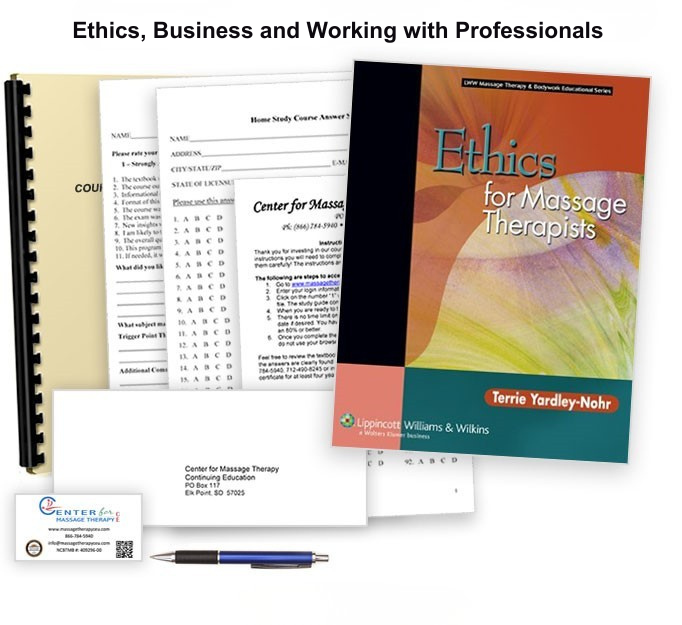
Cost includes all materials. Shipping, if applicable, is a flat rate.
Newly updated in September 2026. Learn the fundamental ethical and professional responsibilities of massage therapists. This 4-hour continuing education course provides an overview of professional ethics, scope of practice, confidentiality, informed consent, professional boundaries, sexual conduct, dual relationships, business practices, and record keeping.
Whether you are reviewing ethics requirements or looking to strengthen your understanding of professional responsibilities, this course provides practical information to help you make ethical decisions and maintain appropriate standards of practice throughout your massage therapy career.
In this course, you will learn:
The principles of professional ethics in massage therapy
Ethical guidelines and standards of practice
Scope of practice and professional responsibilities
Informed consent and client confidentiality
Professional boundaries and appropriate client relationships
Transference, sexual conduct, and dual relationships
Ethical considerations in business practices
Proper documentation and record keeping
SOAP charting and professional documentation
How ethical standards support safe and professional client care
Why Take This Course?
Ethical decisions are part of everyday massage therapy practice. Understanding professional boundaries, informed consent, confidentiality, scope of practice, and appropriate client relationships can help massage therapists protect both themselves and their clients.
This 4-hour course provides a practical review of ethical principles and professional standards, making it a useful option for massage therapists who need ethics continuing education or want to strengthen their knowledge of responsible professional practice.
Define professional ethics and explain their importance in massage therapy.
Describe ethical guidelines and standards of professional practice.
Explain the importance of practicing within an appropriate scope of practice.
Describe informed consent and client confidentiality requirements.
Identify appropriate professional boundaries and client relationships.
Recognize ethical concerns involving transference, sexual conduct, and dual relationships.
Describe appropriate documentation and record-keeping practices.
Explain how ethical decision-making supports professional and responsible client care.
Text: Ethics for Massage Therapists by Corrine Mollet Rubida, BS, LMT, 123 pages
Course instruction guide
20-question multiple-choice final exam
Course evaluation
Certificate of Achievement upon completion
Unlimited phone support for course-related questions
The Center for Massage Therapy Continuing Education, LLC is an Approved Provider through the National Certification Board for Therapeutic Massage and Bodywork (NCBTMB); Approved Provider number 409296-00.
Our massage online continuing education hours are also accepted by the American Massage Therapy Association (AMTA), Associated Bodywork and Massage Professionals (ABMP), and most state boards.
For more information on individual state requirements and approvals, please visit our Approvals page and click on your state.
To the point, easy, well outlined, mail option was nice! - Rose Lee Fleming, LMT
Very pleased with quality of info in your courses. - Rebecca McCarthy, LMT
The information is valuable and held my interest throughout. - A. McKim, LMT
The course was to the point. – Nicholas Henry, LMT
I like that I am able to take this course at home. - M. Boucher, LMT
I like that the information on "Ethics for massage Therapists" was easy to obtain, relate to and understand. and that the process was well explained. - K. McKinney, LMT
This course was accessible to a blind person using a screen reader, thank you, thank you, thank you!!! - Jamie R., LMT
What is an important difference between legal requirements and ethical standards?
A. Ethical standards apply only to NCBTMB certificants, while legal requirements apply to all massage therapists.
B. Legal requirements provide broader guidance for professional conduct, while ethical standards establish legal obligations that must be followed.
C. Ethical standards and legal requirements are always identical.
D. Legal requirements establish legal obligations that must be followed, while ethical standards can provide broader guidance for professional conduct.
Which statement correctly describes counter-transference?
A. It occurs when a client transfers feelings from another relationship onto the therapist.
B. It refers to a client's difficulty understanding the therapist's professional role.
C. It refers to the therapist's emotional responses toward a client that may be influenced by the therapist's own experiences or unresolved feelings.
D. It occurs whenever a therapist disagrees with a client's treatment preferences.
Draping
Which communication practice supports an ethical professional relationship?
A. Using professional terminology even when the client does not understand it.
B. Sharing personal opinions with clients to demonstrate empathy.
C. Avoiding statements that could be misunderstood as guarantees.
D. Avoiding difficult conversations about fees, policies, or treatment changes.
Course Author
About the Instructor
Corrine Rubida, BS, LMT
Corrine completed her massage therapy training at Gateway College of Massage Therapy in 1997 and earned a Bachelor of Science degree in Healthcare Administration in 2012. She has been practicing and teaching massage therapy since 1997 and currently holds a massage therapy license in South Dakota. She is also a member of the ABMP. In 2002, Corrine founded the Center for Massage Therapy CE to make professional massage continuing education courses available both online and by mail. Since then, she has developed more than 100 home-study massage continuing education courses and has taught live courses for AMTA and the Gateway College of Massage Therapy.
.jpg)