
SOAP Notes for Massage Therapists: A Complete Guide to Massage Therapy Documentation
SOAP Notes for Massage Therapists: A Complete Guide to Massage Therapy Documentation
SOAP notes are a commonly used method of documenting massage therapy sessions. They provide a structured way for massage therapists to record what a client reports, what the therapist observes, the therapist's professional assessment, the services provided, the client's response to treatment, and plans for future care.
But are SOAP notes required for massage therapists? What should be included in a massage therapy SOAP note? How detailed should the documentation be? And how long should massage therapy records be kept?
The answers can vary depending on the state where you practice, your licensing board, your practice setting, and the type of services you provide.
This guide explains SOAP notes for massage therapists, including what S, O, A, and P mean, what to document, common documentation mistakes, confidentiality, record retention, scope of practice, and state-specific requirements.
Important: Massage therapy documentation and record-retention requirements vary by state. Always verify current requirements with the licensing board or regulatory agency that governs massage therapy where you practice.
What Is a SOAP Note?
A SOAP note is a structured format used to document a client's condition, the therapist's observations and professional assessment, the treatment provided, and plans for future care.
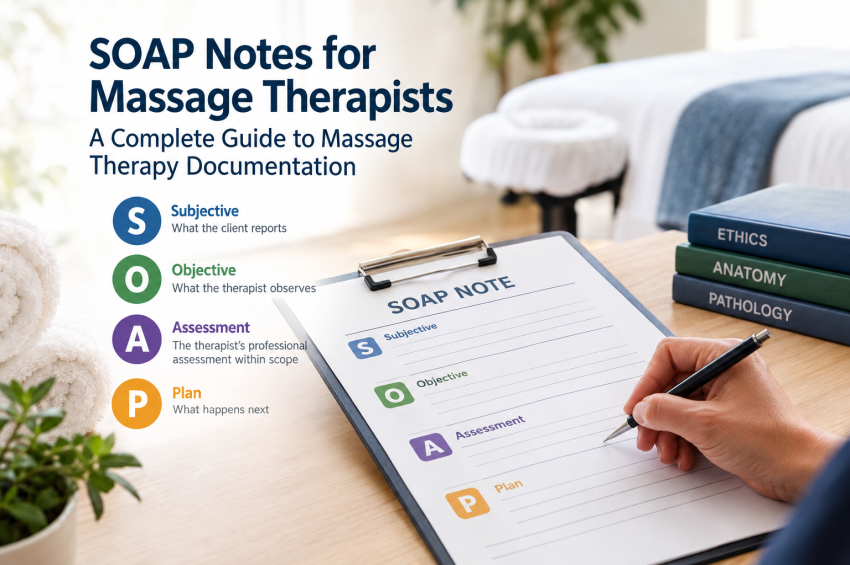
SOAP stands for:
- S — Subjective: What the client reports
- O — Objective: What the therapist observes
- A — Assessment: The therapist's professional assessment within their scope of practice
- P — Plan: What is planned for future treatment or follow-up
SOAP notes are used in many healthcare and allied health settings. Massage therapists may also use SOAP notes to organize client documentation and track changes over time.
However, SOAP notes are not automatically required in every state. Some states require massage therapists to maintain client records but allow flexibility in the format used. For example, Washington requires massage therapists to document professional services but specifically states that therapists are not required to use SOAP notes.
Other states may have more specific documentation requirements. The important point for massage therapists is that documentation requirements are state-specific.
Why Are SOAP Notes Important for Massage Therapists?
Good documentation can serve several important purposes in a massage therapy practice.
1. SOAP Notes Document the Client's Care
A client record provides a written history of the services provided.
Depending on applicable requirements, documentation may include the client's concerns, relevant health information, observations, treatment provided, client response, and plans for future care.
2. SOAP Notes Help Track Client Progress
Massage therapy documentation allows therapists to compare information from one appointment to the next.
For example, a therapist may document changes in:
- Client-reported discomfort
- Muscle tension
- Movement
- Posture
- Treatment response
- Functional concerns within the therapist's scope
- Treatment goals
- Areas requiring modification
Over several sessions, these records can help the therapist identify meaningful changes in the client's presentation.
3. SOAP Notes Support Continuity of Care
A well-maintained record allows a therapist to review previous sessions before treating a returning client.
This can be particularly useful when a client returns after several weeks or months or when treatment is being provided as part of a larger healthcare team.
4. SOAP Notes Can Support Professional Accountability
Accurate documentation can help demonstrate what services were provided and how the therapist responded to the client's presentation.
Records may become relevant in circumstances such as:
- A client complaint
- A licensing-board inquiry
- An insurance claim
- A request for records
- A legal matter
- Communication with another healthcare professional
5. Documentation Can Help Identify When Referral Is Appropriate
Massage therapists need to recognize situations that may require modification or discontinuation of massage or referral to another healthcare professional.
Documenting relevant client reports, observations, treatment modifications, and referral recommendations can help create a clear record of the therapist's professional decision-making.
What Does SOAP Stand for in Massage Therapy?
The four sections of a SOAP note each have a specific purpose.
S — Subjective
Subjective information is what the client reports.
This section generally includes information obtained directly from the client.
Examples include:
- The client's primary concern
- Location of discomfort
- Description of symptoms
- Changes since the previous appointment
- Response to previous treatment
- Activities that may affect symptoms
- Client-reported improvements or worsening
Example:
Client reports increased neck and shoulder tension after working extended hours at a computer. Client rates discomfort as 5/10 and reports that symptoms are worse at the end of the workday.
The key is to distinguish what the client says from what the therapist personally observes.
Remember:
S = Subjective = What the client reports.
O — Objective
Objective information is what the therapist observes or identifies through appropriate assessment within their scope of practice.
Depending on the therapist's training and state requirements, objective information may include:
- Observable posture
- Movement observations
- Range-of-motion observations when appropriate
- Areas of soft-tissue tension
- Palpable changes in tissue
- Tenderness or sensitivity reported during assessment
- Observable changes from previous sessions
- Other relevant findings within the therapist's scope
Objective documentation should be descriptive and factual.
Example:
Increased soft-tissue tension noted in the upper trapezius and cervical paraspinal region. Client demonstrates decreased cervical rotation compared with movement observed at the previous session.
Avoid turning an observation into a medical diagnosis.
Remember:
O = Objective = What the therapist observes.
A — Assessment
Assessment is the therapist's professional interpretation of the information gathered during the session.
For massage therapists, this section should remain within the therapist's education, training, and legal scope of practice.
An assessment may describe:
- The client's response to treatment
- Changes since the previous session
- Areas of continued tension or discomfort
- Whether the current treatment approach appears appropriate
- Treatment modifications
- Factors affecting treatment
- Whether referral may be appropriate
Massage therapists should be cautious about using diagnostic language that implies they have diagnosed a medical condition when they are not legally authorized to do so.
Example:
Instead of:
Client has a cervical disc herniation.
a massage therapist might document:
Client reports persistent neck discomfort with intermittent symptoms into the right arm. Treatment modified due to reported symptoms. Client encouraged to seek evaluation from an appropriate healthcare professional.
This approach documents what the client reported, what the therapist did, and what recommendation was made without making a diagnosis outside the therapist's scope.
Remember:
A = Assessment = The therapist's professional assessment within scope.
P — Plan
Plan describes what is intended for future care.
Depending on the client and practice setting, this may include:
- Plans for the next session
- Recommended treatment frequency
- Areas to reassess
- Planned treatment modifications
- Self-care recommendations within scope
- Monitoring the client's response
- Referral or follow-up recommendations
Example:
Continue massage therapy as tolerated. Reassess neck and upper-back tension at next visit. Modify treatment based on client response.
Remember:
P = Plan = What happens next.
What Should a Massage Therapist Document?
The exact requirements vary by state, but a massage therapy client record may include:
- Client identification information
- Date of service
- Relevant health history
- Reason for the appointment
- Client-reported concerns
- Relevant contraindications or precautions
- Objective observations
- Assessment findings within scope
- Areas treated
- Massage techniques or services provided
- Duration of treatment
- Client response
- Treatment modifications
- Self-care recommendations
- Referral recommendations
- Future treatment plans
- Therapist identification or signature, when required
Not every item is necessary for every session.
The goal is to create documentation that is accurate, relevant, timely, and sufficient to explain the services provided.
How Detailed Should Massage Therapy SOAP Notes Be?
There is no universal rule that every SOAP note must be a certain length.
A good SOAP note should provide enough information to explain what occurred during the session without including unnecessary or irrelevant information.
A useful documentation test is to ask:
Why did the client receive treatment?
What did the client report?
What did I observe?
What treatment did I provide?
How did the client respond?
What is the plan going forward?
For example, a note that says:
"Massage performed. Client tolerated treatment well."
may not provide enough useful information to document the session.
A stronger note could explain the client's primary concern, relevant findings, treatment provided, response, and plan.
The goal is not to write the longest possible note. The goal is to create a clear and meaningful record.
Massage Therapy SOAP Note Example
Here is a simplified example of a massage therapy SOAP note.
S — Subjective
Client reports increased upper-back and neck tension following several long days working at a computer. Client reports discomfort rated 5/10 and states that symptoms are worse at the end of the workday.
O — Objective
Increased soft-tissue tension noted in the upper trapezius and cervical paraspinal region. Client demonstrates decreased cervical rotation compared with movement observed during the previous session.
A — Assessment
Client presents with increased muscular tension in the upper back and neck associated with the client's reported occupational activities. Treatment approach modified according to client tolerance.
P — Plan
Continue massage therapy as appropriate. Reassess neck and upper-back tension at the next session. Encourage appropriate self-care and ergonomic considerations within scope.
This example demonstrates the distinction between what the client reports, what the therapist observes, the therapist's assessment, and the future treatment plan.
Common SOAP Note Mistakes for Massage Therapists
Even when therapists understand the basic SOAP format, documentation problems can occur.
1. Writing Notes Several Days Later
Documentation should be completed promptly after the session whenever possible. Waiting too long can increase the likelihood of forgetting important information or recording inaccurate details.
Some jurisdictions may also establish specific time requirements for completing records. For example, Washington's massage therapy rules state that records should be recorded within 24 hours of treatment.
2. Using Vague Language
Statements such as:
"Client is doing better."
or
"Massage performed."
do not provide much useful information.
Instead, document relevant details about the client's report, observations, treatment, response, and plan.
3. Making Diagnoses Outside Your Scope
Massage therapists should understand the scope of practice that applies to their profession and state. Do not use documentation to imply that you have diagnosed a medical condition when you are not legally authorized to do so.
Your documentation should reflect what you are qualified and authorized to observe, assess, and document.
4. Documenting Something That Did Not Happen
Never document a treatment, assessment, conversation, referral, or observation that did not actually occur. Client records should be accurate and truthful.
5. Copying the Same Note for Every Appointment
Templates can save time and improve consistency, but each note should accurately reflect the individual session. Copying and pasting identical documentation can make it difficult to demonstrate meaningful changes in a client's presentation or treatment.
6. Including Too Much Irrelevant Information
More documentation is not automatically better. Keep records focused on information that is relevant to the client's care and the services provided.
7. Failing to Document Treatment Modifications
If treatment is changed because of a client's symptoms, response, health information, or other relevant circumstances, document the change when appropriate.
8. Forgetting to Document Referrals
If you recommend that a client seek evaluation from another healthcare professional, document that recommendation when appropriate.
Do Massage Therapists Have to Use SOAP Notes?
Not necessarily.
This is one of the most important things massage therapists should understand about SOAP documentation.
There is no single nationwide rule requiring every massage therapist to use SOAP notes.
Documentation requirements are determined by the laws, regulations, licensing board requirements, and practice circumstances applicable to the therapist.
For example, Washington requires massage therapists to document professional services but specifically states that therapists are not required to use SOAP notes. The state's rules allow different documentation formats depending on the type of massage and practice setting.
Other jurisdictions may have more specific requirements for documentation.
Therefore, massage therapists should not assume that a SOAP requirement—or exemption—from another state applies to them.
The best approach:
Check the current rules for the state where you practice.
State-Specific Massage Therapy Documentation Requirements
Massage therapy documentation requirements can vary significantly from state to state.
Some states may specify:
- What information must be documented
- When records must be completed
- How records must be stored
- How long records must be retained
- Who may access the records
- How records must be released
- How records must be disposed of
- Whether a particular documentation format is required
For example, Washington requires documentation of professional services and specifies record-retention requirements, while allowing therapists flexibility in the format of documentation.
This is why a massage therapist should always verify documentation requirements through the current state massage therapy licensing board or regulatory agency.
Your state's continuing education requirements and your state's documentation requirements are separate issues. A course provider being approved for continuing education does not necessarily determine the documentation rules for your practice.
For current state-specific massage therapy continuing education information, visit the Massage Therapy CE Requirements by State section of MassageTherapyCEU.com.
How Long Should Massage Therapy Records Be Kept?
There is no single nationwide record-retention period for massage therapists. Record-retention requirements vary by jurisdiction.
For example, Washington requires massage therapy records for clients age 18 and older to be retained for at least three years from the date of last treatment. For clients under 18, records must be retained for at least three years after the client reaches age 18.
Indiana's massage therapy regulations require client files and business records to be maintained for at least four years from the date of service and require secure handling of client information.
These examples demonstrate why massage therapists should not assume that a three-year, four-year, or other universal retention period applies to their practice.
Check your state's current requirements and consider any additional requirements that may apply because of your employer, insurer, contracts, or practice setting.
Confidentiality and Massage Therapy Records
Massage therapy records may contain private health and personal information. Therapists should take appropriate steps to protect client information, whether records are maintained on paper or electronically.
Good recordkeeping practices include:
- Store paper records securely.
- Protect electronic records with appropriate security measures.
- Use strong passwords and access controls.
- Limit access to authorized individuals.
- Avoid discussing client information where unauthorized people may hear it.
- Follow applicable state confidentiality requirements.
- Securely dispose of records when the applicable retention period has ended.
- Understand the privacy requirements that apply to your specific practice.
Confidentiality is also an important component of professional ethics and massage therapy practice.
MassageTherapyCEU.com offers continuing education addressing ethics, confidentiality, scope of practice, professional boundaries, and record keeping. For example, the Ethics for Massage Therapists course covers confidentiality, consent, scope of practice, business practices, record keeping, and sample SOAP charts.
Does HIPAA Apply to Massage Therapists?
HIPAA does not automatically apply to every massage therapist.
HIPAA applies to covered entities and business associates as defined by federal law. HHS explains that covered healthcare providers generally include providers that electronically transmit health information in connection with certain standardized transactions.
Therefore, whether a particular massage therapist or massage practice is subject to HIPAA depends on the circumstances of the practice. However, massage therapists should not interpret this to mean that client information does not need to be protected when HIPAA does not apply.
State privacy laws, professional regulations, employer policies, contracts, insurance requirements, and ethical responsibilities may still require confidentiality and secure recordkeeping. When in doubt, determine which privacy and confidentiality requirements apply to your specific practice.
Paper vs. Electronic SOAP Notes
Massage therapists may use paper records, electronic documentation systems, practice-management software, or another appropriate recordkeeping system.
Regardless of the format, records should be:
- Accurate
- Legible
- Timely
- Secure
- Organized
- Accessible when legitimately needed
- Protected from unauthorized access
- Retained for the required period
Electronic documentation can make it easier to locate previous sessions and track client progress. However, massage therapists should choose documentation systems carefully and understand how client information is stored, protected, backed up, and accessed.
Your documentation system should also allow you to meet any state-specific requirements that apply to your practice.
SOAP Notes and Massage Therapy Scope of Practice
SOAP documentation should always reflect the massage therapist's professional role and legal scope of practice. This is especially important when documenting clients who present with pain, injury, neurological symptoms, or diagnosed medical conditions.
A useful way to approach documentation is to distinguish between:
Client report
"Client reports numbness in the right hand."
Therapist observation
"Client reports discomfort during wrist movement."
Professional assessment
"Treatment modified due to reported symptoms."
Referral recommendation
"Client encouraged to seek evaluation from an appropriate healthcare professional."
This type of documentation helps distinguish what the client reported from what the therapist observed and assessed.
For more information, see our Resource Center article Massage Therapy Scope of Practice: What Massage Therapists Can and Cannot Do.
SOAP Notes for Condition-Specific Massage
SOAP notes can be particularly useful when a client receives massage therapy for a specific condition, injury, or treatment concern. Depending on the client's presentation and the therapist's scope of practice, documentation may address:
- The client's primary concern
- Relevant health history
- Contraindications
- Precautions
- Client-reported symptoms
- Relevant observations
- Treatment modifications
- Techniques used
- Client response
- Changes over time
- Referral considerations
- Future treatment plans
The therapist should remain within the legal scope of massage therapy and avoid implying that massage therapy is diagnosing a medical condition when the therapist is not authorized to make that diagnosis.
SOAP Notes and Treatment Planning
SOAP notes can also help connect assessment findings to treatment planning.
A therapist can use the documentation process to consider:
What is the client reporting?
↓
What am I observing?
↓
What can I appropriately assess within my scope?
↓
What treatment is appropriate?
↓
How did the client respond?
↓
What should happen next?
This creates a logical progression from the client's presentation to the treatment plan.
It also provides a useful record of how the therapist's approach changes when the client's condition or response changes.
How to Write Better SOAP Notes
The following habits can make massage therapy documentation more effective.
Be specific.
Document relevant details rather than relying on vague phrases.
Separate client reports from therapist observations.
Make it clear whether information came from the client or was observed by the therapist.
Stay within your scope of practice.
Use language that accurately reflects your professional role.
Document meaningful changes.
If the client's symptoms, presentation, treatment, or response changes, document those changes.
Document promptly.
Complete the record as soon as reasonably possible after the session.
Be consistent.
Use a documentation system that allows you to meet applicable state and practice requirements.
Protect confidentiality.
Keep records secure and limit access to authorized individuals.
Know your state's requirements.
Your state may establish specific requirements for documentation, retention, confidentiality, and record access.
SOAP Note Checklist for Massage Therapists
Use this checklist as a quick review after each session.
Subjective
- What did the client report?
- What is the client's primary concern?
- Has anything changed since the previous session?
- Did the client report a change in symptoms or response to treatment?
Objective
- What did I observe?
- What relevant findings did I identify within my scope?
- Were there contraindications or precautions?
- Were there meaningful changes from the previous session?
Assessment
- What is my professional assessment within my scope?
- How did the client respond to treatment?
- Did treatment need to be modified?
- Is referral appropriate?
Plan
- What is planned for the next session?
- What should be reassessed?
- Were self-care recommendations provided?
- Were referral or follow-up recommendations made?
Frequently Asked Questions About SOAP Notes for Massage Therapists
What does SOAP stand for in massage therapy?
SOAP stands for Subjective, Objective, Assessment, and Plan. Subjective information describes what the client reports, objective information describes what the therapist observes, assessment describes the therapist's professional assessment within scope, and plan describes future treatment or follow-up.
Are SOAP notes required for massage therapists?
Not in every state. Some jurisdictions require massage therapists to maintain records but do not require the SOAP format. Other jurisdictions may have more specific documentation requirements.
Always check the current requirements in the state where you practice.
What should a massage therapist document?
Documentation requirements vary, but a massage therapist may need to document the date of service, client concerns, relevant health information, observations, assessment, treatment provided, client response, treatment modifications, and future plans.
How detailed should a massage therapy SOAP note be?
A SOAP note should be detailed enough to provide a meaningful record of the session. It does not necessarily need to be lengthy. Focus on information that is relevant to the client's care and the services provided.
Can massage therapists use SOAP note templates?
Yes. Templates can make documentation more efficient and consistent. However, the therapist should customize the note for each client and session rather than copying identical information from previous appointments.
Can massage therapists use abbreviations in SOAP notes?
Abbreviations may be appropriate when they are commonly understood in the practice setting. Avoid abbreviations that could create confusion or be interpreted differently by another person reviewing the record.
Can massage therapists diagnose conditions in SOAP notes?
Massage therapists should only make assessments and use terminology that is within their legal scope of practice. A therapist should not document a medical diagnosis that they are not qualified or authorized to make.
How long should massage therapy records be kept?
There is no single nationwide retention period. Requirements vary by state. For example, Washington requires certain massage therapy records to be retained for at least three years, while Indiana requires client files and business records to be maintained for at least four years.
Are massage therapy SOAP notes confidential?
Client records should be protected from unauthorized access and disclosure. Specific confidentiality and privacy requirements vary depending on state law, practice setting, and whether federal HIPAA requirements apply.
Can SOAP notes be electronic?
Yes, electronic documentation may be appropriate when permitted by applicable laws and practice requirements. Electronic records should be stored securely and protected against unauthorized access.
What is the difference between a massage intake form and a SOAP note?
A massage intake form generally collects information about the client before or at the beginning of care, such as health history, medications, relevant conditions, goals, and other information needed to determine whether massage is appropriate.
A SOAP note documents an individual treatment session and can be used to track the client's presentation, treatment, response, and future plan.
Both can be components of a complete client record.
Final Thoughts on SOAP Notes for Massage Therapists
SOAP notes give massage therapists a practical framework for documenting client care and tracking progress over time.
Remember the four components:
S = Subjective — What the client reports
O = Objective — What the therapist observes
A = Assessment — The therapist's professional assessment within scope
P = Plan — What happens next
However, massage therapists should not assume that SOAP notes are legally required in every state. Documentation requirements, record-retention periods, confidentiality requirements, and acceptable documentation formats can vary by jurisdiction.
The best approach is to maintain records that are accurate, relevant, timely, secure, and appropriate for your professional scope of practice, while following the current laws and regulations that apply to your practice. Always verify current requirements with your state massage therapy licensing board or other appropriate regulatory authority.
Related Massage Therapy Resources
Continue learning with these MassageTherapyCEU.com resources:
- Massage Therapy Scope of Practice: What Massage Therapists Can and Cannot Do
- Massage Therapy Contraindications: When Should Massage Be Avoided?
- Massage Therapist's Complete Guide to Massage CEUs
- Ethics and Professional Boundaries for Massage Therapists
- State Massage Therapy CE Requirements
- NCBTMB Board Certification Renewal Requirements
MassageTherapyCEU.com also offers continuing education courses related to ethics, professional practice, documentation, communication, treatment planning, contraindications, and scope of practice.