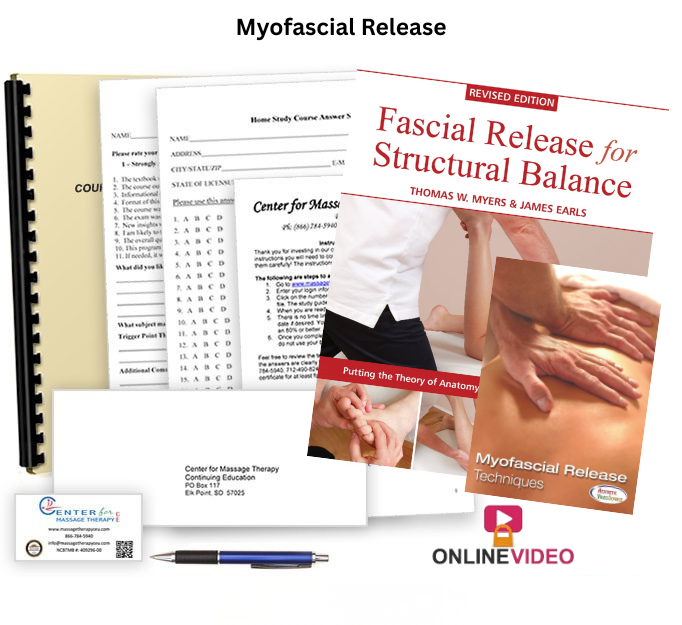
Cost includes all materials. Shipping, if applicable, is a flat rate.
Learn the fundamentals of structural bodywork and how it can be incorporated into massage therapy in this 14-hour continuing education course. Structural bodywork focuses on posture, body structure, and functional limitations while incorporating concepts associated with Ida Rolf and Feldenkrais.
The course explores the history and theory of structural bodywork along with myofascial release, stretching, and practical techniques. Detailed photographs and step-by-step descriptions provide guidance for incorporating structural bodywork techniques into a regular massage therapy routine.
In this course, you will learn:
The definition and principles of structural bodywork
The history and evolution of structural bodywork
The theories associated with Ida Rolf and Feldenkrais
The relationship between posture, structure, and functional limitations
Indications and contraindications for structural bodywork
Basic structural bodywork techniques
Myofascial release techniques used in structural bodywork
Stretching techniques and applications
How structural bodywork techniques may be incorporated into a massage routine
Practical techniques through detailed photographs and step-by-step instructions
Why take this course?
Understanding the relationship between posture, body structure, and movement can provide massage therapists with additional information when assessing clients and planning massage sessions. Structural bodywork offers another approach for exploring these relationships while incorporating techniques such as myofascial release and stretching.
This 14-hour course combines the history and theory of structural bodywork with practical technique instruction. It is a good choice for massage therapists who want to expand their knowledge of structural approaches and incorporate additional techniques into their existing massage practice.
Define structural bodywork and describe its basic principles.
Explain the history and evolution of structural bodywork.
Describe the influence of Ida Rolf and Feldenkrais on structural bodywork.
Explain the relationship between posture, body structure, and functional limitations.
Identify indications and contraindications for structural bodywork.
Describe basic structural bodywork techniques.
Identify myofascial release and stretching techniques used within structural bodywork.
Explain how structural bodywork techniques may be incorporated into a massage therapy routine.
Apply information from detailed photographs and technique descriptions to understand structural bodywork applications.
Text: Structural Bodywork textbook by John Smith, 248 pages
Course guide with instructions
72-question multiple-choice examination
Course evaluation
Certificate of achievement upon completion
Unlimited phone and email support for any questions
The Center for Massage Therapy Continuing Education, LLC is an Approved Provider through the National Certification Board for Therapeutic Massage and Bodywork (NCBTMB); Approved Provider number 409296-00.
Our massage continuing education courses are also accepted by the American Massage Therapy Association (AMTA), Associated Bodywork and Massage Professionals (ABMP), and most state boards.
For more information on individual state requirements and approvals, please visit our Approvals page and click on your state.
The textbook is so easy to read and understand technique explanations. - Cindy Hummel, LMT, LPN
Excellent Study - as usual - always learn so much through the CE courses I've taken from you. - Curtisa Beneke
Exactly what I needed. Fast delivery, easy to follow, and I learned a lot from this course. - Rita Burwell
There is so much valuable information in this study, in this textbook that is vital for all bodyworkers. - Sharell Thomas
What is structural bodywork?
A. A modern somatic practice that directly modifies our structure, evoking within it greater order, length and alignment
B. An ancient somatic practice that indirectly modifies our structure, evoking within it lesser order, length and alignment
C. A modern somatic practice that indirectly modifies our structure, evoking within it lesser order, length and alignment
D. An ancient mental practice that directly modifies our structure, evoking within it greater order, length and alignment
Which of the following is an example of a tensegrity structure?
A. Little boy logo
B. Blocks in a stack
C. A tent
D. All of the above
Which of the following is the correct client assisting movement when performing the MFR technique - pectoralis minor?
A. Arm adduction
B. Arm abduction
C. Arm rotation
D. Arm flexion
Course Author
About the Instructor
Corrine Rubida, BS, LMT
Corrine completed her massage therapy training at Gateway College of Massage Therapy in 1997 and earned a Bachelor of Science degree in Healthcare Administration in 2012. She has been practicing and teaching massage therapy since 1997 and currently holds a massage therapy license in South Dakota. She is also a member of the ABMP. In 2002, Corrine founded the Center for Massage Therapy CE to make professional massage continuing education courses available both online and by mail. Since then, she has developed more than 100 home-study massage continuing education courses and has taught live courses for AMTA and the Gateway College of Massage Therapy.