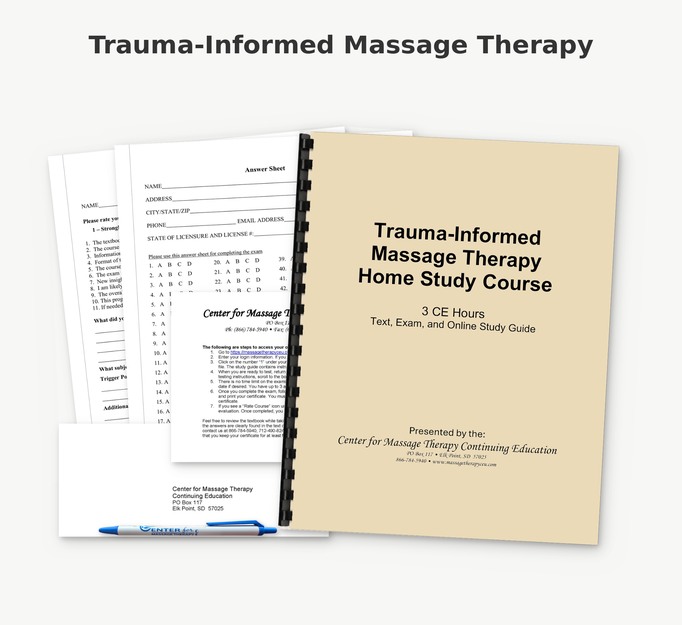
Cost includes all materials. Shipping, if applicable, is a flat rate.
Brand New Course! Trauma-Informed Massage Therapy is a continuing education course designed to help massage therapists understand the effects of psychological trauma and incorporate trauma-informed principles into everyday practice. The course explores how trauma and stress may influence the nervous system, pain perception, body awareness, and responses to physical touch.
Emphasis is placed on practical applications, including effective communication, informed consent, professional boundaries, and adapting massage techniques to support individual client needs. Realistic case studies demonstrate how therapists can respond to challenging situations while maintaining appropriate professional responsibilities and scope of practice.
In This Course, You Will Learn:
How psychological trauma and stress may affect the nervous system, pain perception, and responses to touch.
The six principles of trauma-informed care and their application to massage therapy.
Strategies for effective communication, informed consent, and supporting client autonomy.
Practical ways to modify massage pressure, positioning, draping, and treatment pacing.
How to recognize and appropriately respond to client discomfort or unexpected emotional reactions.
Professional considerations involving boundaries, confidentiality, scope of practice, and referrals.
How to apply trauma-informed principles through practical examples and case studies.
Why Take This Course?
Understanding trauma-informed care helps massage therapists create a more comfortable, respectful, and client-centered treatment experience. This course provides practical strategies for adapting hands-on techniques, responding to individual client needs, and navigating challenging situations with confidence and professionalism.
Whether you are an experienced massage therapist or looking to strengthen your client-centered approach, this course offers valuable knowledge that can be incorporated into your everyday practice.
Definepsychological trauma and trauma-informed care, including the potential effects of traumatic experiences on physical and emotional well-being.
Describehow stress and trauma may influence the nervous system, pain perception, body awareness, and responses to physical touch.
Identifythe six principles of trauma-informed care and explain their application to communication, informed consent, client autonomy, and treatment planning.
Applytrauma-informed principles to massage therapy sessions by adapting techniques, pressure, positioning, draping, and treatment pacing while responding appropriately to client discomfort.
Evaluateprofessional and ethical responsibilities related to trauma-informed massage therapy, including boundaries, confidentiality, scope of practice, and appropriate referrals.
Certificate of achievement for 3 CE hours upon completion
Unlimited phone and email support for any of your questions
The Center for Massage Therapy Continuing Education, LLC is an Approved Provider through the National Certification Board for Therapeutic Massage and Bodywork (NCBTMB); Approved Provider number 409296-00.
Our online massage continuing education courses are also accepted by the American Massage Therapy Association (AMTA), Associated Bodywork and Massage Professionals (ABMP), and most state boards.
For more information on individual state requirements and approvals, please visit our Approvals page and click on your state.
Comming soon....
Which statement accurately describes trauma-informed massage therapy?
A. It is a specialized massage technique designed to remove psychological trauma from the body
B. It involves identifying traumatic memories through physical assessment
C. It is a form of trauma-specific psychological treatment
D. It is an approach to professional conduct that considers how services are delivered and how clients experience the treatment relationship
Which of the following correctly identifies SAMHSA's six principles of trauma-informed practice?
A. Safety; trustworthiness and transparency; peer support; collaboration and mutuality; empowerment, voice, and choice; and cultural, historical, and gender issues
B. Safety; diagnosis; emotional processing; clinical intervention; behavioral assessment; and psychological recovery
C. Trust; physical assessment; trauma identification; treatment planning; emotional release; and recovery
D. Safety; relaxation; specialized massage techniques; nervous system regulation; emotional expression; and referral
Which of the following should be avoided when responding to unexpected emotional distress?
A. An acknowledgement of what the client is experiencing
B. Suggesting that an emotional reaction is an expected part of massage treatment
C. Pausing to determine if the client wishes to continue
D. Listening without judgement
Course Author
About the Instructor
Corrine Rubida, BS, LMT
Corrine completed her massage therapy training at Gateway College of Massage Therapy in 1997 and earned a Bachelor of Science degree in Healthcare Administration in 2012. She has been practicing and teaching massage therapy since 1997 and currently holds a massage therapy license in South Dakota. She is also a member of the ABMP. In 2000, Corrine founded the Center for Massage Therapy CE to make professional massage continuing education courses available both online and by mail. Since then, she has developed more than 100 home-study massage continuing education courses and has taught live courses for AMTA and the Gateway College of Massage Therapy.