
How to Verify Whether a Massage Therapy CE Course Is Accepted for License Renewal
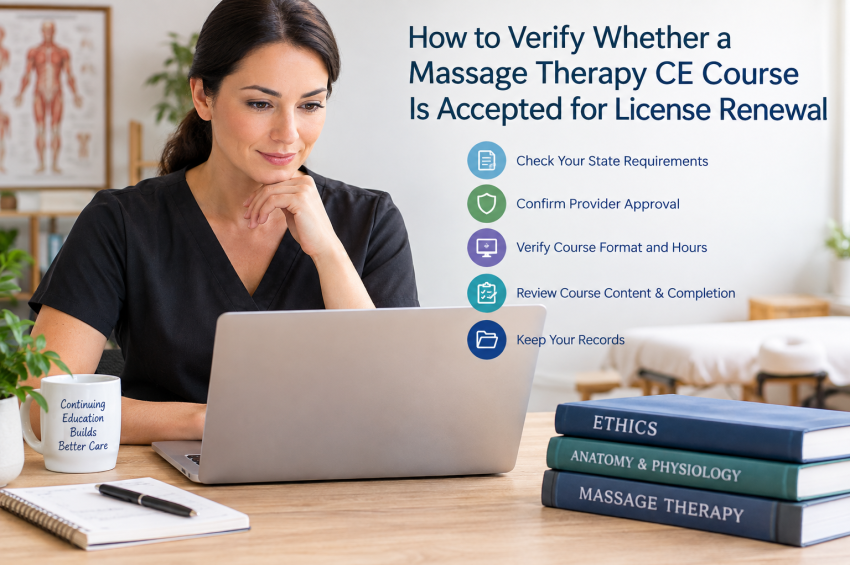
How to Verify Whether a Massage Therapy CE Course Is Accepted for License Renewal
Choosing a continuing education course is about more than finding a topic that interests you or selecting a course with the right number of CE hours. Before enrolling, massage therapists should make sure the course meets the continuing education requirements for the state in which they are licensed.
Massage therapy continuing education requirements vary by state. A course that satisfies renewal requirements in one state may not satisfy the requirements in another. Some states have specific subject requirements, limits on certain types of education, provider approval requirements, or restrictions on how continuing education may be completed.
The good news is that verifying a course is usually straightforward when you know what information to check. This guide explains what massage therapists should look for before enrolling in a CE course and how to confirm that the education they complete will count toward license renewal.
Start With Your State Licensing Board
The first and most important step is to identify the licensing authority responsible for your massage therapy license. Your state's massage therapy board, department of health, professional licensing agency, or another regulatory agency establishes the requirements you must meet to renew your license.
Do not assume that a course is acceptable simply because another massage therapist completed it, because it is advertised as a massage therapy CE course, or because it is approved by a professional organization. Your state's licensing requirements determine what you need for your particular license.
Start by reviewing the current continuing education information published by your state's licensing authority. Look for information about the total number of hours required, the renewal period, required subjects, acceptable course formats, provider requirements, and any restrictions or limitations.
Because licensing requirements can change, it is important to verify the information for your current renewal period rather than relying solely on information from an older article, social media post, or discussion forum.
Determine How Many CE Hours You Need
Once you have located your state's requirements, determine exactly how many continuing education hours you need to complete before your next renewal. Some states require a specific number of hours during each renewal period, while others use different renewal schedules or have additional requirements that apply to particular licensees. You should also determine whether your state permits any unused hours to carry over to a future renewal period.
The number of hours alone does not determine whether a course will count. A 12-hour course is not necessarily useful for a therapist who needs a specific two-hour subject, and completing more hours than required does not necessarily satisfy a separate mandatory subject requirement. Before enrolling, compare the number of hours offered by the course with the requirements for your license.
Check Whether Your State Requires Specific Subjects
Many massage therapists assume that they simply need to complete a certain number of general CE hours. In some states, however, part of those hours must cover specific subjects. Depending on the state and renewal period, required subjects may include areas such as ethics, professional boundaries, communicable disease, HIV/AIDS, prevention of medical errors, sexual harassment, domestic violence, cultural competency, or other topics established by the licensing authority.
If your state requires a particular subject, make sure the course specifically addresses that requirement. Do not assume that a course qualifies simply because the subject is mentioned briefly in the course description.
For example, if your state requires a specific number of ethics hours, look for a course specifically identified as an ethics course and verify that it provides the required number of hours. If your state requires a particular topic, confirm that the course is designed to satisfy that requirement.
Check Whether the Provider Must Be Approved
Some states have specific requirements concerning who may provide continuing education. Other states may recognize education from approved providers or organizations without requiring the individual massage therapist to obtain separate approval for each course. This is one reason it is important to understand the distinction between a course provider and a course itself.
A provider may have an approval or recognition from a national organization, while the state licensing board may have its own rules regarding acceptable continuing education. In some situations, a state may recognize education from certain providers; in others, the therapist may need to document that the course meets specific criteria.
Before enrolling, determine whether your state requires an approved provider and, if so, whether the provider you are considering meets that requirement. MassageTherapyCEU.com is an NCBTMB Approved Provider, #409296-00. However, therapists should still review their own state's requirements because state licensing rules are separate from NCBTMB's requirements.
Understand the Difference Between Provider Approval and State Acceptance
Provider approval and state acceptance are related but are not necessarily the same thing. An organization such as the National Certification Board for Therapeutic Massage & Bodywork (NCBTMB) may establish standards for approved providers and board certification. A state licensing board, however, establishes the requirements for renewing a massage therapy license in that state.
This distinction matters because massage therapists may encounter statements such as "NCBTMB approved," "nationally approved," or "approved provider" when researching CE courses. Those statements can provide useful information about the provider, but they should not replace checking your state's current licensing requirements. The safest approach is to identify what your state requires and then determine whether the provider and course meet those requirements.
Check Whether Your State Limits Online or Home-Study CE
Another important consideration is how the continuing education is delivered. Some states place limitations on online, distance-learning, correspondence, self-study, or home-study education. Other states may permit these formats without the same restrictions. Requirements can also change over time.
Before purchasing a course, check whether your state permits the specific format you are considering. If a course is offered online, determine whether your state recognizes online education for massage therapy license renewal. If materials are mailed for home study, determine whether home-study or correspondence education is permitted and whether there are limits on the number of hours that may be completed in that format. Do not assume that a course's availability online automatically means it will be accepted in every state.
Look at How the Course Is Completed
In addition to the delivery format, check how the course documents successful completion. Depending on the provider and the requirements of your state, a course may include a final examination, evaluation, attendance verification, completion documentation, or another method of demonstrating that the course was completed.
Before enrolling, determine what you will need to do to receive your certificate of completion and whether you will have documentation showing the number of CE hours earned. A course certificate should clearly identify important information such as the course title, number of continuing education hours, provider information, and completion date. Keep this documentation with your professional records.
Make Sure the Course Covers the Entire Requirement
A course can be relevant to massage therapy without necessarily satisfying every requirement attached to a particular CE category. For example, a general massage therapy course may provide valuable professional education but may not substitute for a state-required ethics course. Similarly, completing an ethics course does not necessarily satisfy a separate requirement for a specific health or safety topic. When reviewing a course, compare the actual course subject with the wording of your state's requirement. Pay particular attention to:
- The required number of CE hours
- Required subject areas
- The renewal period
- Acceptable education formats
- Provider approval requirements
- Limits on specific types of education
- Examination or completion requirements
- Documentation and certificate requirements
- Any restrictions on self-study, online, or home-study education
Taking a few minutes to compare these details before enrolling can prevent problems later.
Check the Date the Information Was Verified
Continuing education requirements are not permanent. Licensing boards can change renewal periods, required subjects, acceptable formats, and other rules. When using a website that summarizes state requirements, look for a date showing when the information was last reviewed or verified.
A current state requirements page should also direct you to the appropriate licensing authority so you can review the official information yourself. At MassageTherapyCEU.com, our state requirement pages are designed to help massage therapists understand the CE requirements that apply to their state. We also provide links to the appropriate regulatory resources so therapists can verify requirements directly with their licensing authority.
Keep Your Own CE Records
After completing a course, keep your certificate and other completion records in a safe place. Do not assume that the course provider will always be able to provide a replacement certificate years later. Your license renewal may require documentation of completed education, and you are responsible for maintaining records according to the requirements that apply to your license.
Consider keeping a digital copy of every certificate in addition to your original records. Organizing certificates by renewal period can also make it easier to determine which courses you completed and which requirements they satisfied. Useful records may include:
- Course certificates
- Course titles and descriptions
- Dates of completion
- Number of CE hours earned
- Provider information
- Examination or completion records when applicable
- Receipts or enrollment records
- Any correspondence with your licensing board concerning CE requirements
What If the Requirements Are Unclear?
Sometimes the information published by a licensing authority may not answer your specific question. This can happen when a requirement is written broadly, when rules have recently changed, or when it is unclear whether a particular type of course qualifies.
When you cannot determine whether a course will count, contact the licensing authority responsible for your license before enrolling. When contacting the board or licensing agency, provide specific information about the course, including the course title, number of hours, subject matter, provider, delivery format, and any applicable provider approval information.
Written confirmation can be particularly useful when the question involves an unusual circumstance or a requirement that is not clearly addressed in the published rules. Keep a copy of the response with your CE records.
Do Not Rely on a Course Title Alone
A course title can tell you what a course is about, but it does not necessarily tell you whether the course satisfies a particular licensing requirement. For example, a course with "ethics" in its title may not automatically satisfy every state's ethics requirement. Likewise, a course described as "online CE" may be subject to different rules depending on the state in which the therapist is licensed.
Read the course description, learning objectives, completion requirements, number of hours, and provider information before enrolling. The goal is not simply to find an interesting course. The goal is to make sure the education you complete fits the requirements that apply to your license.
A Simple Checklist Before You Enroll
Before purchasing a massage therapy continuing education course, ask yourself the following questions:
- How many CE hours does my state require for this renewal period?
- Does my state require specific subjects?
- Does this course cover a subject I need?
- Is the provider acceptable under my state's rules?
- Does my state allow this course format?
- Are there limits on online, home-study, or self-study education?
- Does the course provide documentation of completion?
- How many CE hours will appear on my certificate?
- Will I need to complete an exam or another requirement?
- Have I checked the current information from my licensing authority?
If you can answer these questions before enrolling, you will have a much better understanding of whether the course is appropriate for your license renewal.
The Bottom Line
The best way to determine whether a massage therapy CE course will count toward license renewal is to start with your state's current requirements and work backward from there. Check the required number of hours, required subjects, provider requirements, acceptable course formats, and documentation requirements before enrolling.
Do not rely solely on a provider's marketing language or on what another massage therapist says worked for them. Licensing requirements are specific to each state and can change over time.
MassageTherapyCEU.com provides state-specific continuing education information and NCBTMB-approved courses to help massage therapists find education that fits their professional needs. However, your state's licensing authority is the final source for determining the requirements that apply to your license.
Taking a few minutes to verify the requirements before purchasing a course can help ensure that the CE you complete is useful not only for your professional education, but also for your license renewal.